The Transgender cowboy Anna Kerrigan’s Cowboys (2022)
Ana Kerrigan’s Cowboys concerns a transgender boy who embraces the cowboy as part of their transition story. The film arrived amidst a cluster of American films about transgender children - Celine Sciamma’s Tomboy (2011), Silas Howard’s A Kid Like Jake (2018), and Fisher Stevens’s Palmer (2021) in which Justin Timberlake plays an ex-con who finds redemption in caring for his neighbours’ transgender son. Set in rural Montana – coded as White working class – Cowboys centres on Sally (Jillian Bell), a single mother bringing up ten-year-old child, Josie (Sasha Knight), with occasional help from her ex-husband, Troy (Steve Zahn), a warm-hearted rogue with bipolar disorder. Josie is struggling with an identity crisis: he hates wearing dresses and admires the Stetsons and boots worn by Troy and his bowling buddies. It is Troy – the transgressive outsider – who recognises what Sally cannot yet name: that Josie is a transgender boy. His response is characteristically cowboy: He steals a horse and takes Joe to the Montana mountains – thereby enabling both to become the outlaws they most admire.
Kerrigan’s views on her characters’ development are of interest. She starts with an image in a wilderness and a label – outlaws – and writes the film to explain their presence to herself. Surprisingly, “mental health” and “transgender” identity emerge only later as the connection that makes them “soulmates” in a household and community that doesn’t “get them.” Cowboys focus is not simply prejudice but the coercive force of interiorised social norms, as Sally, Kerrigan explains in a later interview, “is trying to protect her child from the wrath of the community, but in effect, becomes a personification of that judgment.” It is a point that Troy grasps more viscerally than theoretically – a “cowboy” who seems capable of voting Trump, but who recognises Joe because he loves him. People, Kerrigan claims, are not monolithic but complicated – a sentiment expressed by Troy when he loses his medication and they get lost.
Ana Kerrigan explains the inspiration behind the film and what makes Troy and Joe cowboys.
In linking gender dysphoria to mental illness Kerrigan is straying into contentious ground. While in Britain the two are detached in the US the separation is less secure because of the lingering entanglement of identity with medical and insurance frameworks. Kerrigan does not attempt to resolve this tension: her concern is not “explaining” gender dysphoria in terms of something it is not (a form of autism or depression) but the struggle to locate a viable sense of self within competing narratives and the role that medical interventions, whether antidepressants or hormone suppressants, may have in this. There is no simple opposition between the “natural” and “artificial” in Troy’s identity. A series of flashbacks show Troy without his medication: his super-fast work as a gardener; his chatty attendance at an AA meeting – moments which present not recovered essence but a destabilised subject. Yet it is precisely this instability that links Troy to Joe through their shared difference.
“We’re complicated; we live in the grey zone; that’s what makes us great; that’s what makes us cowboys.”
Troy can’t hold down a job; his best friend is Native American; he is childishly irresponsible; he drives a truck with buffalo horns; he sticks up for the marginalised with displays of explosive violence – he is, in short, a cowboy at heart. Like Shane, Troy is an outsider who is beloved by Joe for his outsider status; but the reason that Shane never comes back is because if he did, he would be in therapy.
Joe’s fixation on the cowboy as vehicle for transition is presented in a scene that records a family bowling trip. While the women talk tacky romance, Joe is transfixed by the bowlers – their actions aestheticized in slow motion, their movements free and easy in their Stetsons, big buckles, and cowboy boots. It is not simply masculinity as identity, but by what masculinity can do – how it moves, how it is allowed to be active rather than passive.
“It’s all a big mistake: Am I crazy, completely insane?”
Chris Vaughn’s backing track does the psychological work: “It’s all a big mistake: Am I crazy, completely insane? / I lost your attention; you don’t think of me the same. / I’m no longer in your thoughts, have you broke the tie that binds, / Well I think I’m going out of your mind.” The playful pronoun shifts – “I’m going out of your mind” – highlight Joe’s central dilemma: He thinks that his assigned gender is “all a big mistake” and he is eager to “break the tie that binds” before he goes crazy.
In the very next scene Joe is raiding the school “Lost and Found” room (an apt description of the process that he believes that he is enacting on himself) to assemble the clothes needed to build a cowboy identity. The mirror before which he dresses intensifies the scene’s theoretical richness because it allows both character and viewer to watch gender being constructed according to a gendered social order. The “mirror scene” is now as central to the cultural aesthetics of transgenderism as “the closet” is to discourse on homosexuality, transforming identity into a question of authenticity.
A second mirror scene shows Joe in an outdoor clothing store, his reflection sitting alongside pictures of a cowboy in Stetson and tight jeans - masculinity reduced to performance and brand image.
“This one screams Paul Newman”
The scene explores the changing signification of the cowboy identity and the reactionary judgment of mainstream society. Troy’s crudeness exposes the destabilisation of once solid masculine signifiers: the pink boots that have become symbols of camp consumerism, and the shirt summons up Newman’s languid cowboy persona in ironic contrast to Wayne’s craggy manliness. To invoke Newman at this stage, even unconsciously, is to draw attention to the Western’s queer stylization.
As such, the costume that Joe chooses (with its emphasis on the performative detached from notions of authenticity) makes it the perfect outfit for gender transition: gender as something you put on and learn to inhabit. However, it is precisely the dangers wrought upon the mythical cowboy by such commodification that Joe’s cousin seeks to counter through his sneer - “Your clothes, you look like a dyke.” It’s the voice of small-town America, frightened by the threat to masculinity that Joe’s cowboy identity exposes, and punishing him by conflating gender and sexuality into a slur.
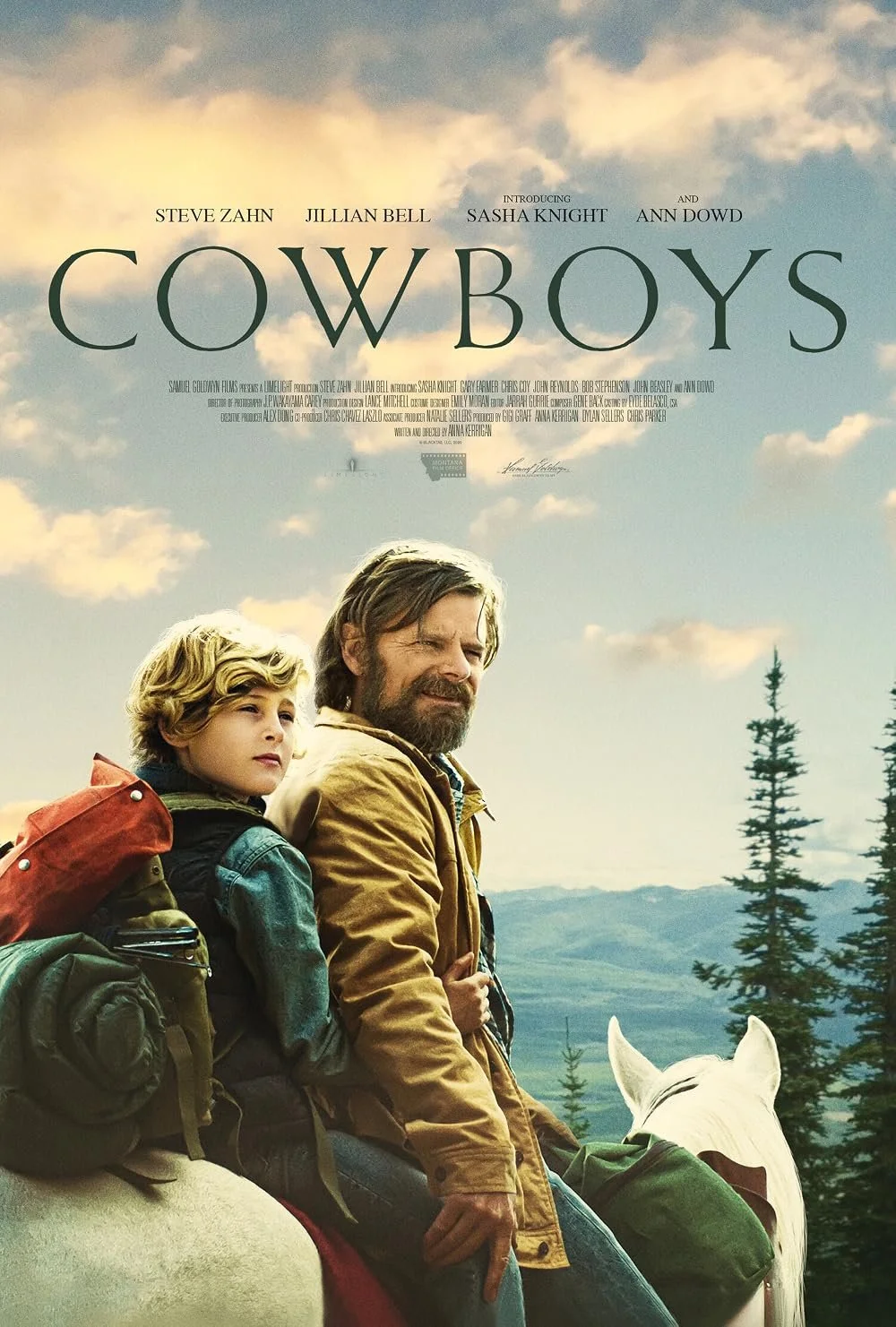
As is usual in the Western, the outlaws break for the border; yet Kerrigan is ambivalent about borders as metaphors for transition because it suggests an imagined and culturally accepted transition from one binary state to another, missing out the messiness in between. Those promotional posters of Joe and Troy overlooking beautiful valleys sell a libertarian fantasy of freedom from small-town conformity; however, it is illusory.
“We’re cowboys, son!”
Kerrigan makes this clear as they become lost in a degraded landscape of stumps, sludge and industrial residue. It reflects Joe’s mental disintegration, but also the worst excesses of “Drill Baby Drill” capitalism, which can be linked to the erosion of trans rights at the hands of Trump. Trans bodies unsettle the exploitative relationship in which women and nature can be degraded while being placed on a pedestal, and in doing so they threaten the heteropatriarchal norms. The film represents these norms through the figure of Sally’s brother, Jerry (Chris Coy), who volunteers to help the search, but articulates a grievance rooted in entitlement and resentment: “My dad was going to grill out today and now I’m going to miss it because I’m in the middle of nowhere looking for some little girl-boy or whatever.” (102:56). The pejorative conflation of gender categories amidst ruined nature is telling: an exhibition of “carbon-heavy masculinity” in which environmental care is dismissed as unmanly in much the same way as trans bodies. In this context, the scene reveals that environmental exploitation and gender regulation are deeply, and perhaps inextricably, entangled.
The final showdown assembles the familiar Western tableau - a wide river to be crossed, a fugitive with a hostage, a sheriff in pursuit, a posse arriving on the horizon – yet all are mobilised to subvert expectations.
The final showdown – all the Western signifiers subverted.
In this scene, the hostage is in charge; the sheriff is a woman protecting the outlaws from the posse; and the river is a site of disruption rather than potential liberty. When Troy is shot by the SWAT team, Troy’s claim “You’re such a good boy” take on a special significance; for they embody not simply an ethical judgement (you’re a nice boy who sticks by his dad) but also the validation of the authenticity of his masculine performance. Furthermore, Kerrigan, is careful to not let the scene drift into an easy celebration of patriarchal inheritance. When Joe picks up Troy’s gun (an obvious symbol of patriarchal inheritance) he is unable to kill the shooter, thereby rejecting a world governed by a masculine violence. What Cowboys seeks is a more expansive emotional range than the spirit of justified revenge embodied by the cowboy.
There is, however, a feel-good ending. The closing scene on the school bus completes the film’s retooling of the Western myth.
Joe’s first day at school: the cowboy hero who silences the saloon into which he walks!
It is Joe’s first day at a new school and he is nervous. When he steps onto the bus it falls silent before whispered voices can be heard claiming this is the Joe Johnson. He has achieved the iconic status afforded to the cowboy hero who silences the saloon into which he walks. When one nerdy kid asks, “Just wondering, could you tell us about your trip!” he speaks for a generation relaxed about gender and still in the thrall of cowboy stories. They are more interested in his journey as Joe Johnson rather than his journey to Joe Johnson. They all love a cowboy story!